Check a planning sketch before treating its shapes as comparable
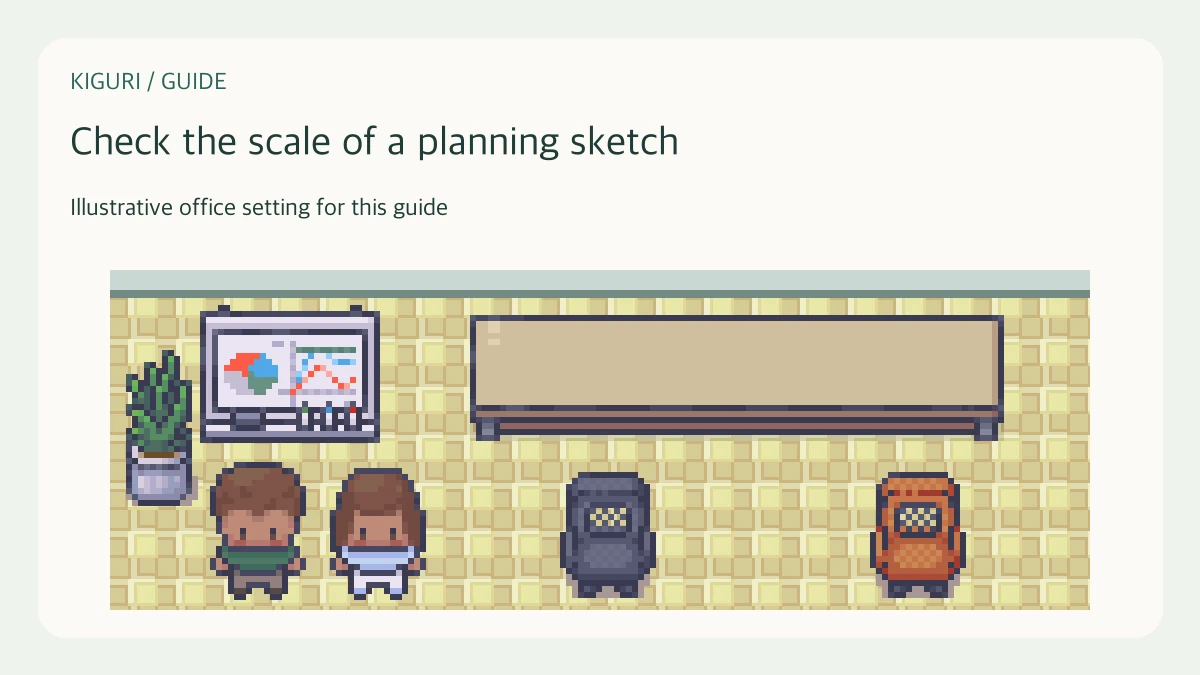
A planning sketch may show the right labels while stretching the shapes between them. That can be harmless in a schematic, but misleading when people compare proportions as though every unit had the same displayed size. Check the drawing's stated purpose and scale before using it to discuss a layout.
Establish what the sketch claims
For this fictional practice example, an office-planning cartoon represents a rectangle twenty units wide and ten units high. Its grid claims one equal-length unit in each direction. The exported illustration is 480 pixels wide and 480 pixels high.
These dimensions belong only to the invented drawing. They are not Kiguri tile measurements, sprite dimensions, furniture collision bounds, or a real office survey. Decide whether the sketch is meant to preserve a common scale or simply explain relationships. An intentionally schematic diagram can remain useful without supporting proportional comparisons.
Check each axis against a known span
Keep the represented extent and the image extent separate. Horizontally, 480 pixels divided by twenty units gives twenty-four pixels per unit. Vertically, 480 divided by ten gives forty-eight pixels per unit. The stated equal-length units are therefore displayed at different scales.
Record the two factors and the spans used to derive them. If the only evidence is an unlabeled screenshot, do not invent its represented dimensions to complete the calculation. Missing units or missing known spans should remain an explicit limitation, even when the picture looks regular.
Identify which comparisons are affected
A square one-unit patch in the example would appear twenty-four pixels wide and forty-eight pixels high. Comparing that rendered shape with another object as though the axes shared one scale would misrepresent its proportions. Labels saying twenty by ten do not cancel the distortion.
Also inspect whether a drawing mixes labels from different units. A correctly shaped rectangle can still be unclear if one span describes a count of grid cells and another describes an unrelated length. Establish the meaning before converting anything. Avoid using tall decorative artwork as a measured floor footprint; appearance and the area an object occupies are different questions.
Correct the rendering or narrow the claim
One proportion-preserving version could be 480 pixels wide and 240 pixels high. Both axis factors would then be twenty-four pixels per represented unit. That is one possible display size, not a required size for every sketch. A smaller or larger version can preserve the same ratio.
Alternatively, retain the existing drawing and label it schematic if its job is only to show adjacency or named destinations. Explain that distances and shape proportions should not be inferred from it. Do not quietly correct the labels to describe the stretched picture when those labels came from the agreed planning model.
Repeat the checks before using the sketch
Compare the known horizontal and vertical spans in the revised version, then inspect a second marked span if one exists. Record which regions remain unmeasured or deliberately schematic. A correct outer ratio does not establish that every internal object was drawn consistently.
Ask another reviewer which conclusions the finished sketch permits. If they infer exact movement distance, capacity, or actual game geometry that was never established, clarify the scope. The resulting scale sheet should support the comparisons the drawing genuinely represents and leave the rest as questions for the appropriate source or actual layout check.