Coordinate and withdraw a raised-hand request
Establish what the hand signal means
A participant wants to ask a question without interrupting an event, while the facilitator needs to see which requests are still outstanding. Use the available conference controls to manage that signal separately from microphones, cameras and speaking permission. The workflow is to raise a request, inspect its returned state and filtered roster, then withdraw it when it is no longer needed.
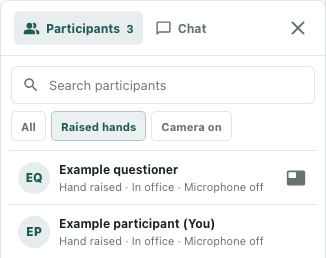
The interface screenshot shows actual controls with fictional records in an isolated local fixture. Example participant, Example questioner and Example facilitator are synthetic entries; the displayed count of three is not a count of real users. No conference was joined, media connected or request delivered to another person. These checks describe the native interface and source model; deployed transport identity and live delivery were not verified.
Raise once and inspect the returned state
In an available formal meeting or audience context, find Raise hand. If the controls are minimized, use Show meeting controls first. A missing meeting interface is not resolved by assuming every office area has the same conference controls.
Selecting Raise hand dispatches a request to set the local participant's hand state. It does not immediately change that state in the interface. In the fictional check, the button remains Raise hand until an explicitly supplied returned conference state marks the hand raised. It then becomes Lower hand. Keep the click and the observed state separate.
A missing control connection can leave a command unsent, and a command error can report a failure. Repeated presses without a changed state do not establish that the facilitator received anything. For an audience participant, raising a hand also does not unmute a microphone, turn on a camera, promote a role or grant permission to speak.
Read the roster with its filters visible
Open Participants and choose Raised hands. Read the displayed identities before treating a row as the person you intend to invite into the discussion. The fictional roster contains Example questioner and Example participant with raised hands, while Example facilitator has none.
Search participants combines with the active filter. Searching for facilitator while Raised hands is selected produces No participants match this filter in the example. That result does not mean the conference has no participants or that nobody has a request. Clear the search and check the chosen filter before drawing that conclusion. The overall count can remain unchanged while the displayed subset changes.
Raised rows are ordered using the client's locally observed hand-state changes. They are not an authoritative global queue with server-assigned request times. A facilitator can use the roster as a practical signal, while checking turn-taking expectations through the actual discussion rather than promising that every browser sees one guaranteed order.
Withdraw the request and check its result
When the question is answered, postponed or no longer needed, choose Lower hand. As with raising, dispatch is not the final state: the fictional button stays Lower hand until a supplied returned state clears the flag. The local row then disappears from Raised hands while the other fictional questioner's request remains.
Closing the participant panel or minimizing meeting controls does not lower a hand. On a smaller screen, the participant drawer can cover the lower control bar. Close that drawer to inspect and use the hand button; do not confuse hiding the roster with withdrawing the request.
Finish by checking whether your hand state actually cleared and whether any unresolved request still needs an agreed communication route. The roster helps coordinate outstanding signals, but it does not prove acknowledgment, a completed speaking turn, admission or successful media delivery. Keep those outcomes separate from the interface's returned hand state.