End a drop-in that continues after a clear refusal
A declined drop-in does not need to become a longer discussion about why the recipient declined. When a request continues after a clear refusal, the useful next step is to end participation and use the team's existing follow-up route. This is an ordinary workplace communication practice, not a claim that Kiguri supplies blocking, reporting or removal controls.
State the boundary once without opening the topic
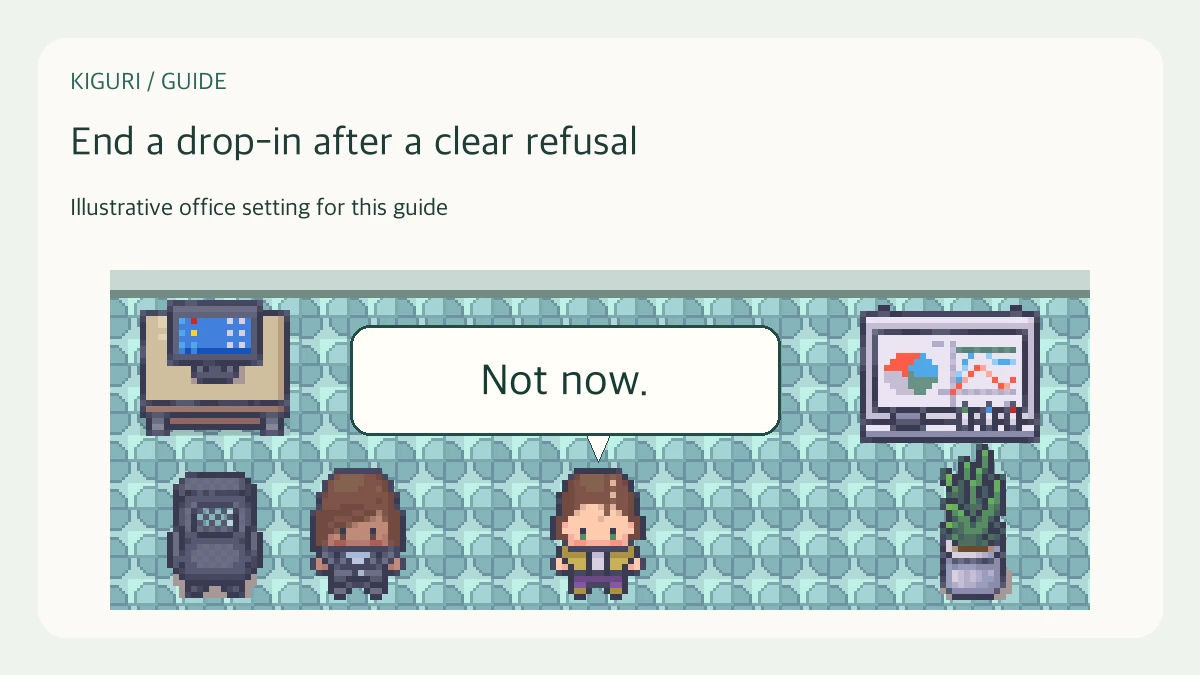
In this fictional office exchange, Lee asks Morgan to discuss a restricted roadmap. Morgan says the topic cannot be discussed here and that they are returning to their work. Lee repeats the request twice. No actual exchange or report occurred; the example illustrates a continued request after a stated limit.
Morgan does not need to explain the roadmap to justify withholding it. A short boundary can identify both the limit and the end of the interaction. If an approved future route exists, Morgan can name it without promising that the request will be accepted. Avoid turning that alternative into an invitation to keep debating the same request now.
End your participation through an available route
If the contact continues, stop answering the substance of the request. Where the connected office media controls show Disconnect audio and video, use that existing control to end the current media connection. Available controls can differ; use only an action you can identify in the medium you are using.
If that control is unavailable, use an established way to leave the communication medium you are actually using. Do not invent a Block or Report button, assume that moving a character removes another person, or promise that later chat cannot arrive. Ending your participation and preventing all future contact are different outcomes.
Use the designated responsible owner
When repeated contact requires follow-up, use the team's existing responsible host or manager route. Keep that follow-up restricted to people who need it rather than broadcasting the exchange to the office. The recipient should not have to restart the declined conversation merely to negotiate a more comfortable ending.
If the team has no usable route, identify that gap with the appropriate owner. A general office agreement can later clarify who handles this situation, but drafting a policy is separate from ending the present interaction. Do not claim that sending a note automatically creates a ticket, triggers moderation, or guarantees a particular response.
Preserve only the relevant first-person facts
A brief boundary-and-follow-up note can state the approximate time, the limit Morgan actually communicated, the continued requests Morgan observed, and whether contact remains unresolved. It should distinguish direct observations from interpretation. Repeating the request twice is an observation; assigning a motive is a separate inference the example does not support.
Avoid copying restricted roadmap details into the note or collecting other people's private conversations to strengthen it. Use the team's approved record and access rules for whatever context is genuinely necessary. The note is not an automatic transcript or a public accusation. Its purpose is to let the responsible person understand the specific continued contact without spreading the underlying sensitive topic.
Check that the interaction has actually ended for you
Morgan can record that they stopped answering and ended their media participation, while leaving later contact or owner follow-up unresolved. That is more precise than saying the situation is fixed when another message could still arrive.
Ask whether the next step depends on Morgan repeating the declined discussion. If it does, revisit the route with the responsible owner. The finish is a clear boundary, an ended or explicitly unresolved interaction, and minimal factual follow-up. This procedure does not resolve every workplace dispute or establish emergency, legal or platform moderation policy.