Organize a training room around the session format
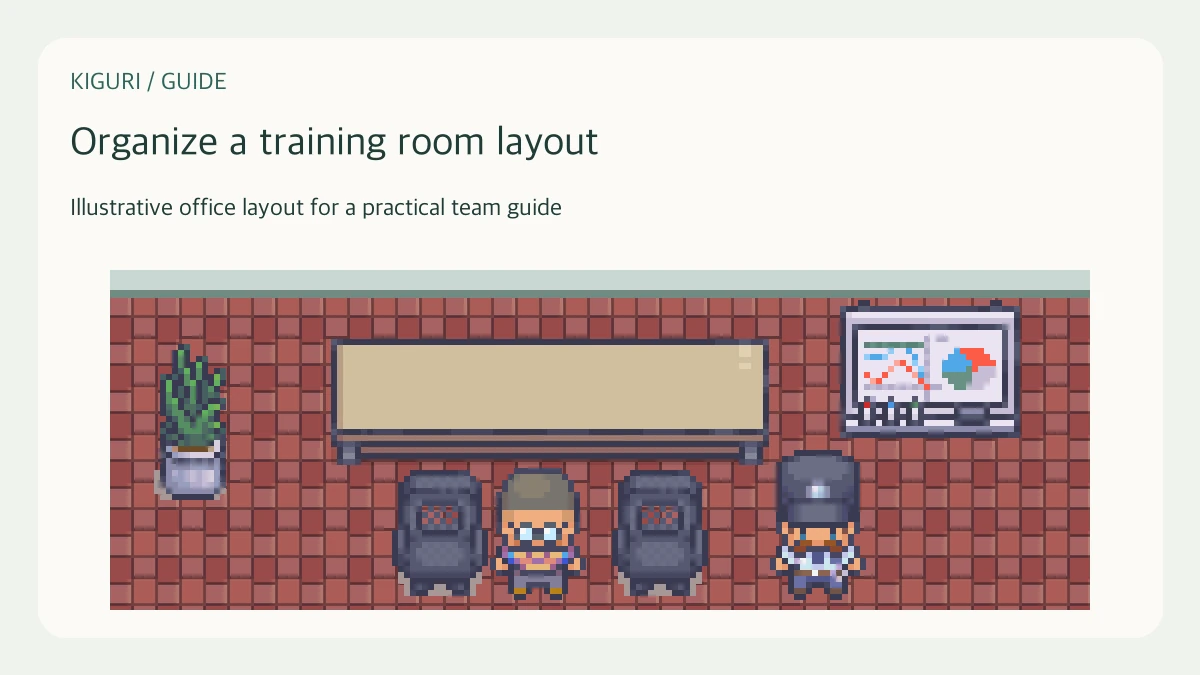
A training room should reflect the session you plan to run. A short demonstration and a hands-on group exercise need different arrangements, even when they use the same furniture. Treat the room as a spatial plan; the layout does not automatically provide attendance tracking, moderation, or instructional features.
Choose the participation pattern
For a demonstration, a clear front focus and simple participant rows may be useful. For a small exercise, grouped tables may better express collaboration. Decide which pattern describes the actual session before placing furniture. Do not combine both at full size merely to cover every possibility. A flexible-looking room can still leave participants unsure where they are supposed to gather.
Leave a usable front area
Reserve space around the demonstration focus, whether that is an interactive board, a configured computer, or a visual meeting point. Check the chosen object's actual behavior separately. Keep the front approach clear of decorative cabinets and plants. A large prop beside the focus can hide the presenter position or make the only practical approach appear to lead somewhere else.
Build one complete participant group
Place one table or workstation arrangement, inspect its complete furniture pieces, and test its approach before repeating it. Keep seats distinct from table edges. If sitting is intended, verify the configured seats instead of assuming every chair image is usable. Use the tested arrangement as a starting point, while allowing enough variation in placement to preserve the room's access routes.
Plan arrival and exit separately
Leave a route from the entrance to the available places without forcing late arrivals through the front focus. Check the last row or farthest group as carefully as the first. Walk back out from each part of the room. A repeated furniture pattern can quietly narrow the final aisle even when the earlier rows leave enough space to move comfortably.
Rehearse the session sequence
Walk through arrival, approaching the focus, moving to a participant place, and leaving the room. Check the actual communication and presentation controls you intend to use before the event. Keep the invitation precise about the meeting location. If the layout requires lengthy instructions to distinguish the front from the back, simplify the furniture pattern or use one clearer landmark.