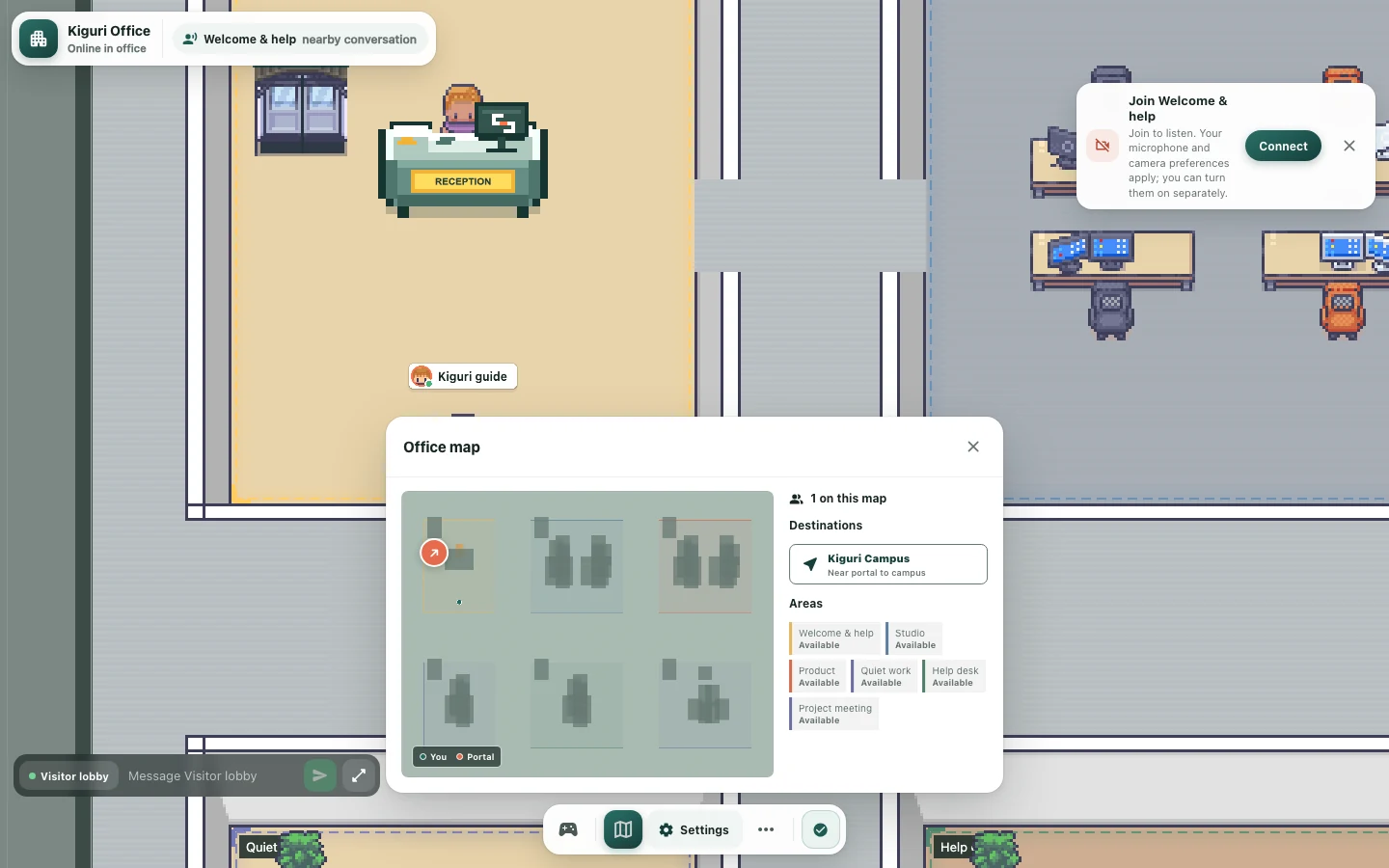
Prepare a team member led tour of your office
A colleague led tour can explain how a team uses its office more clearly than an exhaustive walk past every object. The host can answer questions, demonstrate familiar routes, and distinguish team conventions from product controls. Plan this as a human activity; it does not require an automated tour feature.
Pick three useful destinations
For a newcomer, choose the arrival area, a common gathering spot, and the place used for informal questions. Explain why each matters. Avoid starting with every decorative room or an unfamiliar editor panel. A few memorable destinations give the visitor something useful to practice immediately and reduce the amount they must remember after the tour ends.
Walk the route yourself first
Use the entry link the newcomer will receive and check that the chosen destinations are accessible. Inspect turns, furniture approaches, and any route that requires extra explanation. If you plan to demonstrate a conversation, test the available controls with a willing colleague. Do not infer working audio from the presence of characters or a video-shaped panel on screen.
Invite the visitor to do the movement
At each stop, describe the destination and let the visitor navigate there. Leave time for questions about controls or confusing objects. Following a host can be easier than understanding the route, so ask the visitor to identify the next landmark before moving on. Offer a text description if live audio is inconvenient or unavailable, and let them explore without turning on a camera.
Explain conventions separately from controls
Say, “Our team uses this corner for questions,” rather than implying the corner automatically assigns help requests. Show only the interactions that are present in the accessible workspace. A built-in public product tour, when available, introduces its own scenes; this team tour explains your actual arrangement. Neither should be presented as proof that all workspaces have identical features or access rules.
Finish with one independent return trip
Ask the visitor to return from the final stop to a familiar destination without following the host. This checks whether the route made sense. A longer tour offers more coverage but can leave people less confident about basic navigation. If the return trip is difficult, simplify the explanation or choose a clearer landmark. Share the entry link and the team's written usage expectations so the tour has a practical follow-up.