Rehearse a disagreement without deciding the underlying issue
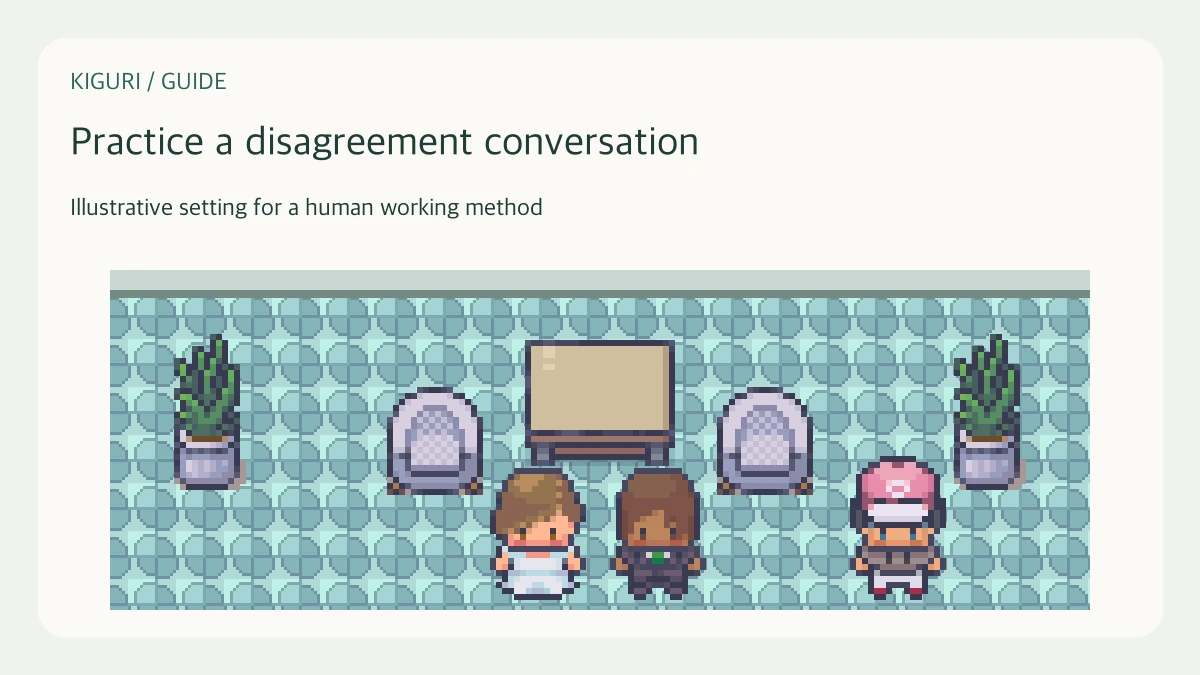
A disagreement rehearsal tests how people represent another concern, not which proposal should win. Use invented roles and a short exchange rather than importing a sensitive workplace conflict. Keep an exchange log in an existing document. The exercise can happen during a virtual-office conversation without becoming a decision meeting or a claim of conflict-resolution expertise.
Give each fictional role a clear concern
In this fictional practice exercise, one role proposes an additional document review because important errors may be missed. Another worries that the extra step will delay a time-sensitive publication. Give both roles a concern and a constraint: the first cannot approve a process that ignores known errors; the second cannot promise an unspecified delay is harmless.
State that nobody will adopt or reject the review step during the rehearsal. Participants may pause, pass, or leave the role. An observer tracks wording and representation, not personality. Agree on these boundaries before asking anyone to perform a difficult exchange.
Record what was actually said
Begin with a brief invented exchange. The turnaround role says another review could delay publication. The error-checking role replies that the other person only cares about speed. The observer records the sentence, the concern it appears to answer, and the attributed motive. Do not treat that motive as an established fact.
Keep observations concrete: an interruption, an unanswered question, or a paraphrase the concern's owner rejects. Avoid labels such as defensive or uncooperative. Those labels infer character without identifying the conversational step that could be repaired. A log of wording gives the replay something specific to change.
Pause for a confirmed paraphrase
Ask the error-checking role to restate the other concern without endorsing it. A possible repair is: you want us to understand the added delay before committing to this step. Let the turnaround role confirm or correct that account. Confirmation means the concern was represented accurately, not that the proposal was accepted.
Repeat in the other direction. The turnaround role might say the concern is avoiding known errors rather than adding review for its own sake. If either role rejects the paraphrase, ask which part is missing. Do not pressure someone to confirm a polished sentence that still changes their meaning.
Replay with a question that preserves both concerns
Return to the same exchange and replace the motive attribution with a neutral question: which errors should the added review catch, and what would we need to understand its delay? The question keeps error coverage and turnaround visible without pretending the rehearsal can answer either factual issue.
A useful boundary phrase is: we can clarify the concerns here, but the actual process owner still needs evidence before choosing. Compare the replay with the first wording. Ask each role whether their concern remains recognizable and whether they consent to continue. A smoother conversation that erases one concern is not an improvement.
Keep the repair separate from the decision
Retain the original phrase, revised phrase, owner confirmation, and unresolved factual questions. Mark which wording helped the fictional exchange and which still caused misrepresentation. Participants can reuse the pattern in an appropriate conversation, but this practice log is not proof that a real disagreement has been resolved.
Stop if the facilitator starts pushing for consensus or treating invented roles as disclosures about actual colleagues. The finish condition is a paraphrase both owners recognize and a next question that preserves both concerns. Choosing the review process belongs in a separate authorized decision with the relevant evidence.