Rehearse a release announcement before it goes out
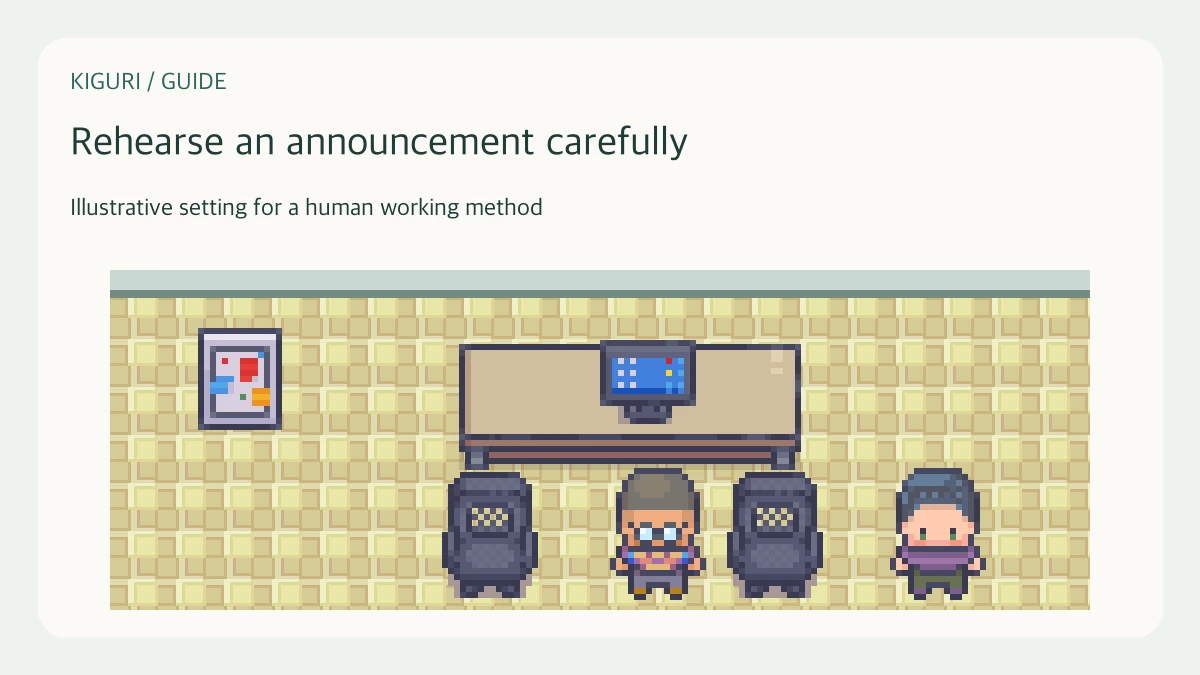
A release announcement is often read by someone who has not followed the development work. That person needs to understand what changed, whether it applies to them, and what to do next. Rehearse the written message against an approved change record before sending it. A meeting in a virtual office can help colleagues review the wording, while the draft remains in the team's normal publication process.
Establish which behavior is ready to describe
Use this fictional practice example: an internal request form now includes a review step for new submissions. Earlier submissions remain on the old path. Collect the approved description of the change and its availability conditions. Keep planned additions in a separate note so they cannot quietly enter the release wording.
Ask the change owner to identify what was checked and what remains limited. A screenshot can illustrate the new field without proving that every account receives it or that older records migrate. The announcement should state the scope that the evidence supports.
Write a reader-sized before-and-after example
Describe one recognizable task. Before the change, a contributor submits a request directly; afterward, a new request passes through the specified review step. Explain the action the contributor needs to take and any prerequisite. Include what happens to an existing request if that distinction matters.
Avoid presenting the team's implementation effort as the reader's main benefit. The message can acknowledge a limitation plainly: earlier submissions continue through the previous process. Use an example labeled fictional when practicing the announcement, and replace it only with approved information for an actual release.
Ask someone to act as the intended reader
Give a colleague the draft without narrating the background. Ask them to explain whether the change affects a new request, an existing one, or both. Then ask what they would do first and where they would look for help.
Record misunderstandings against the exact sentence that caused them. If the colleague assumes automatic migration, inspect whether a broad phrase such as all requests created that expectation. Revise the text and repeat the question. Agreement that the message sounds good is less useful than an accurate explanation of its scope.
Inspect destinations and recovery information
Check that linked instructions lead to the intended accessible page and that dates, time zones, and contact routes are specific where relevant. Identify who can approve the final notice. If a change has an approved fallback or rollback procedure, describe the user-facing consequence without inventing a recovery guarantee.
Decide how an inaccurate announcement would be corrected: which record is authoritative, who updates it, and how affected readers hear about the correction. Keep the rehearsal separate from sending. Discovering a misleading sentence should trigger another review, not an automatic publication action.
Compare the message with its strongest likely misunderstanding
Read the final draft alongside the approved change scope. In the example, confirm that neither the title nor the opening implies existing submissions move automatically. Check that readers can distinguish available behavior from planned work.
If a necessary availability condition cannot be established, pause that claim for the responsible owner. The useful rehearsal output is an accurate draft with resolved wording questions and an identified approval route, rather than a confident announcement whose promise exceeds the actual release.