Review a synthetic example before sharing it more widely
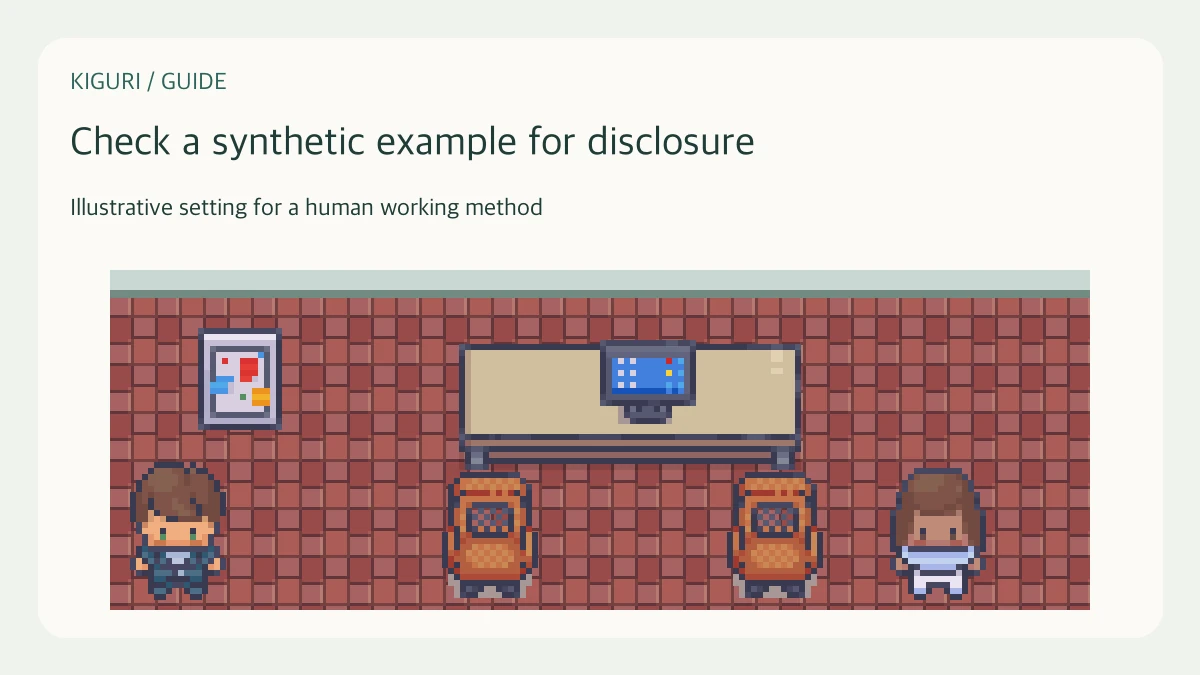
A practice illustration can include more detail than its explanation needs. Review an expressly synthetic example by asking what information the reader must understand and what clues merely identify its invented setting. This is a semantic identification exercise using made-up data. It does not establish anonymity, irreversible redaction, or compliance for a real document containing sensitive information.
Define the teaching purpose and the audience
Create a fictional support illustration about how a request moves from an author to a reviewer. Its labels use sample names, but its caption and exported filename include the distinctive invented project name Juniper Ledger. The intended audience only needs to understand the relationship between request, reviewer, and decision.
Write that learning goal beside the example. Identify which readers will receive the exported artifact and what background text accompanies it. A project name might be unnecessary for this explanation, while distinct role labels are necessary. Decide based on that purpose rather than removing every detail until the example becomes impossible to follow.
Map details across all accessible representations
List where the synthetic identifiers appear: diagram labels, surrounding paragraphs, captions, filenames, linked notes, and accessible document properties. Check the exported copy separately from the editable source. Record locations you can inspect and any representation you cannot check.
Look for combinations as well as individual names. A unique fictional project title, unusual role label, and precise invented event date can point to the same setting even after personal names change. The exercise asks which clues remain connected, not whether replacing one visible name makes the artifact anonymous. Keep all practice details fictional throughout the review.
Replace unnecessary clues consistently
Choose neutral labels that preserve the explanation, such as Author A, Reviewer B, and Decision C. Remove the unnecessary project title from the caption and use an ordinary sample filename. Apply the same naming choices across related paragraphs so a reader does not mistake one role for several different participants.
Avoid placing an opaque visual patch over text and assuming every representation changed. Use editing methods appropriate to the artifact and inspect the resulting export. If you cannot determine what a method leaves behind, record that limitation rather than describing the file as permanently sanitized. No production example needs to be used to perform this practice exercise.
Ask a second reviewer to inspect the combined context
Give the reviewer the exported illustration and the accompanying text that the intended reader will receive. Ask them to identify residual clues linking it to the invented setting. They may find the project name in a filename even though the image itself uses neutral labels.
Record each clue, its location, whether it is needed for the teaching purpose, and the proposed change. Do not treat a reviewer's inability to find another clue as proof none exists. A finite review covers the surfaces inspected; hidden properties, previous copies, or other versions may remain outside it. Keep those limits explicit without turning the exercise into a security certification.
Test meaning after the changes
Have a reader explain how the request reaches the reviewer and what condition leads to the decision. Check that the revised labels still distinguish the roles and preserve the required relationship. If replacing every name with the same word obscures who acts, repair the labels rather than restoring unnecessary identifying detail.
Keep a disclosure map showing removed clues, retained necessary details, inspected surfaces, and unresolved limits. Stop if someone introduces real personal or confidential material; obtain an appropriate separate process rather than extending this fictional exercise by assumption. The useful result is a clearer, less revealing synthetic illustration whose explanation still works, not a guarantee about every copy or future reader.