Run a remote design critique with a clear question
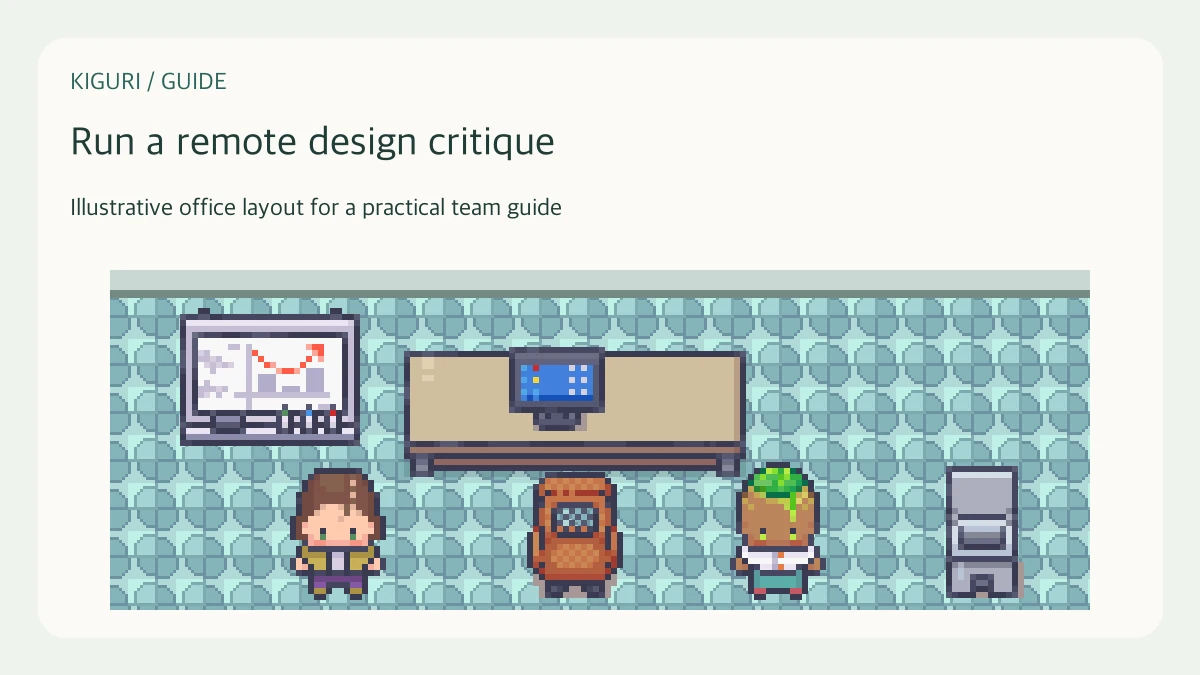
A designer has two possible layouts and needs feedback before spending another day on detail. An open invitation to discuss everything will make the session hard to finish. Use a virtual office as a meeting place, but prepare the review question and decision record separately. This is a facilitation plan, not an automatic critique feature.
Define what the review can change
Write one question before inviting reviewers: can a first-time visitor identify the next action? State the audience, the task, and any constraints that are already fixed. Tell people whether the work is an early sketch or a nearly finished screen. Invite the people who can evaluate that question; a larger audience is useful only when its perspectives are relevant.
Show the task before the solution
Give a short account of what the visitor is trying to do. Then show one layout at a readable scale. If screen sharing is available in your Kiguri session, check with another participant that the intended window is visible. Otherwise, provide an accessible image or document through an agreed channel. Do not make reviewers reconstruct the problem from a crowded screen.
Collect observations before discussion
Allow a few minutes for silent inspection. Ask each reviewer to identify a specific location and describe what they expect a person to do there. Separate an observation such as competing buttons from a preference such as liking blue. Discuss consequences before proposing changes. The facilitator should bring the conversation back to the original visitor task when it drifts into unrelated details.
Choose the next experiment
Group feedback by the decision it affects. Pick one or two changes that can be tested, and identify who will make them. When reviewers disagree, write the competing assumptions instead of forcing an immediate vote. A small follow-up test can resolve an uncertainty more usefully than a long debate. Keep feedback that is outside the current scope in a separate list.
Check the review produced usable feedback
Before closing, ask the designer to repeat the next action and the reason for it. If the answer is only make it cleaner, the critique is still too vague. Record a concrete change, an unresolved question, and a review date. A focused critique leaves some details untouched deliberately; that tradeoff protects time for the decision that matters now.